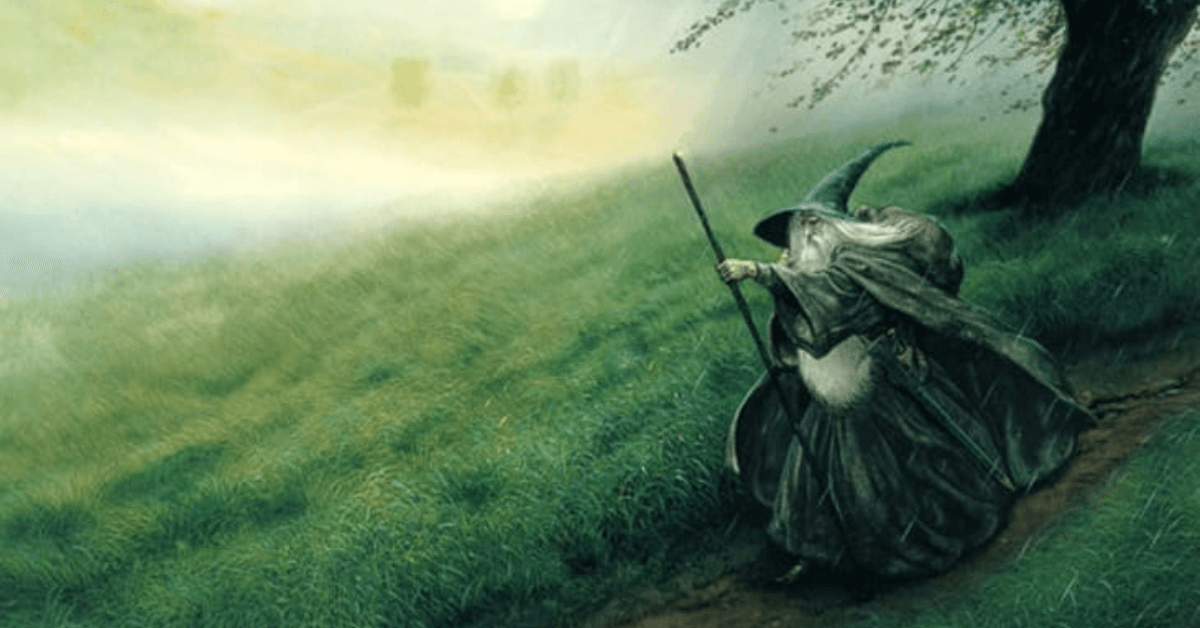
In 2025 I read The Lord of the Rings for the third time, and the first as an adult. I’m more than halfway through The Chronicles of Narnia again, tried out The Wingfeather Saga, revisited His Dark Materials, read The Broken Earth Trilogy, The Green Bone Saga, and am moving through The Space Trilogy and the Earthsea series.
Some of these books are by Christian, some aren’t. Some of these books have Christian themes, and some don’t. I began to wonder what a standard for a Christian Fiction writer would be – sure, Petersen fully intended Wingfeather to be a Christian fantasy series, but does it stand on its own merit? Tolkien was a Christian, but how do we evaluate the books themselves? Even Narnia and The Space Trilogy, thick with Lewis’s “suppositional” cosmologies, should be evaluated by a standard instead of taken for granted as Christian Fiction.
And what would I do – if I put pen to paper?
I wanted some way to put works of art up to the Light, and a way to point myself in that direction with my work. I let the tides of through drift in and out, leaving me ideas in the sand, and I searched for work done ahead of me that I may build on the intelligent discussion of others as I search for a definition of Christian Fiction.
But first – why fiction, at all?
The Role of Fiction: A Signpost For The True Story
If you want the tell the story of the whole Gospel – that is, the ‘good news’ that came at a time and place among a particular people for the good of all – then you must repeat what is contained in the Bible. God has preserved a record of these things through many kinds of documents over several ages, that the core and heart and purpose of His work among humanity may be communicated.
Thus the Bible is, in one sense, the ultimate non-fiction: a set of works which make clear to us the Way, told through histories and poetry and letters and stories of all kinds, pointing towards Jesus the King.
The Bible communicates the True Story. It is the chief of all stories, in that it is an account of what God has done to love us and glorify Himself. No story can be greater.
Fiction is lesser than the True Story, by definition. Fiction is not a lie, but it is a fabrication – a story of something that hasn’t happened. So what is its role? Why make something up? We can look to the True Story for the beginnings of an answer. If we want to see the role that fiction may play, we need look no further than someone whom we can trust who used fiction in part of the True Story: Jesus, telling parables.
In His parables Jesus presented spiritual realities underneath a layer of fictional story. This is a confirmation that fiction may be used as a tool. Jesus’s reasons for using fiction may differ from ours, for He had to set goals according to the audience and circumstance.
The world reads fiction, with many works having great effect of various kinds: A Christmas Carol accellerated Dicken’s social commentary, The Jungle by Upton Sinclair spurring food safety efforts in the U.S.A., and even The DaVinci Code popularising a rather incredible amount of heresy.
Fiction works are a popular and powerful tool, and Jesus used short fiction to work towards His own purposes.
The Definition As A Common Goal
If a Christian is to write fiction, they must consider how a goal of personal obedience to the Lord directs their words. This is a wide goal, and fulfilling it will take practice, reflection, time in the Bible, time spent discussing with trusted, wise friends who are mature in their walk with the, and any other spiritual disciplines we use for growth and improvements as Christians.
A standardized definition can serve as a common writing goal for Christian Fiction writers and must be broad enough to capture all fiction that may be Christian Fiction. This is not the sort of thing to be handled by some kind of centralized organization, of course. A grassroots discussion and organic adoption is the best way for this definition to serve a dispersed community of writers.
The Definition As A Lens For Critique
Secondly, a definition serves as a standardized lens for critique.
Armed with a definition, we may evaluate a work of fiction against a specific standard and make a determination of how well it serves as Christian Fiction. However, this won’t be quantitative, in that you can simply hold a book up to your Christian Fiction ruler, toss it in one pile or another, then move on. Someone’ must read a book to determine if it’s Christian Fiction, and there will be works which reasonable people disagree upon. When we read books with the definition in mind, our question is not “Is this Christian Fiction, yes or no?” but instead “How well does this book serve the purposes of Christian Fiction?”
If the book does not serve the purposes of Christian Fiction at all, then we can comfortably say it is not Christian Fiction. If the book serves at least somewhat the purpose of Christian Fiction, then it is, and if my experience of Christians on the Internet holds true, we can celebrate a successful definition by watching professing Christians yell at each other and continue to erode with their inanity the public trust in the Church.
For example, there is a somewhat recent and popular “Christian Fantasy” book series I read which had merit, but contained some large theological issues communicated through its story which weren’t caught by discerning folks in my community. This definition, fairly created and applied, gives me a standard to evaluate this series against and strengthens my critique. (Let us note, of course, that if I am wrong in my critique, those discussing it with me be equipped with a common standard to weild against my error as well!)
The definition will, of course, strengthen the praise of good work too, and act as a bedrock starting point from which to argue many nuances.
And please note: God can use any book to invite you to think on things and grow and improve and sanctify further. You could even read His Dark Materials – famously not Christian in its message, plot, and setting – and be prompted to think on the nature of the true God.
To summarize, the goal of having a definition is two-fold:
- To provide Christian Fiction writers a broad goal to aspire to
- For the definition to serve as a lens for critique
In my next post, I will review the work that Christian Fiction editor Iola Goulton has done regarding a definition of Christian Fiction. Given her career she is a strong voice in this discussion, and worthy of involvement.
In my third and concluding post on the subject, I will present a definition based on the work of Covenant College professors Hans Madueme and Robert Erle Barham.
If you’re interested in following along, use the ‘subscribe’ button at the bottom of this page.
I would be glad to hear your thoughts on this piece. Please comment, email me, or blog your response.
Leave a Reply